

Losing a pet can be heartbreaking, but you don’t have to face it alone. Across the U.S., there are support groups offering comfort, understanding, and resources for grieving pet owners. Whether you prefer virtual sessions, local meetups, or structured programs, these groups provide a safe space to share your feelings and honor your pet’s memory. Here’s a quick overview of ten options:
- Association for Pet Loss and Bereavement (APLB): Free online chatrooms and resources for pet grief.
- Lap of Love: Free Zoom sessions led by grief coaches, including general and specialty groups.
- Grief Recovery Method (GRM): Paid 6–8 week programs with certified specialists for emotional healing.
- Best Friends Animal Society: Free online tools and resources for coping with pet loss.
- Michigan State University Pet Loss Support Group: Free virtual meetings led by veterinary social workers.
- Colorado State University Argus Institute: Free one-on-one counseling and virtual support for hospital clients.
- Chicago Veterinary Medical Association WINGS: Local in-person peer-support sessions in Chicago.
- PAWS Chicago HEAL Group: Free monthly Zoom meetings open to anyone nationwide.
- Anti-Cruelty Society Virtual Group: Donation-based Zoom sessions with licensed counselors.
- Local Groups: Community-based options like DoveLewis in Portland or regional hotlines.
These groups cater to a range of needs, from free drop-ins to structured programs, ensuring there’s a fit for everyone. Take the first step toward healing by exploring the option that’s right for you.
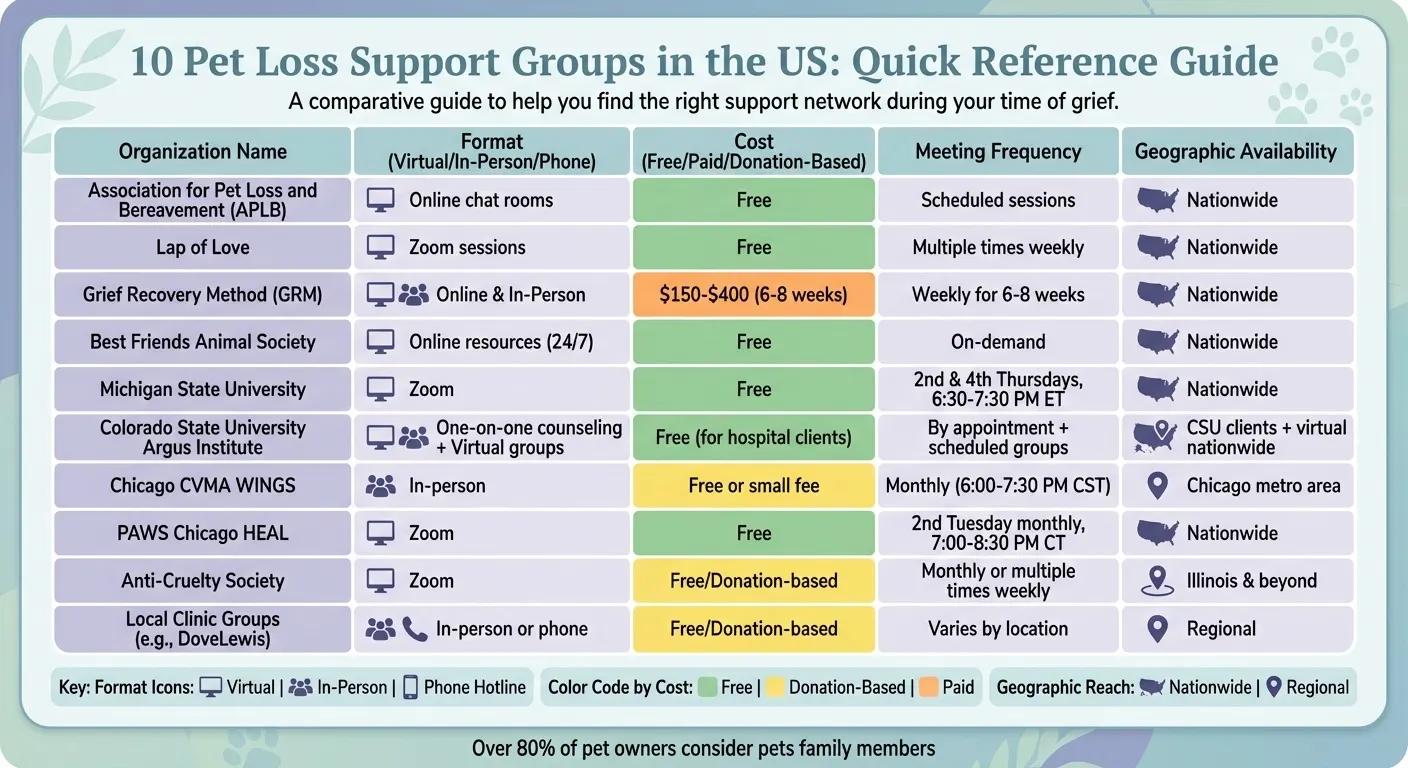
10 Pet Loss Support Groups Comparison: Format, Cost, and Accessibility
Where Can I Find Pet Grief Support Groups?
1. Association for Pet Loss and Bereavement (APLB)
The Association for Pet Loss and Bereavement (APLB) is a nonprofit organization under 501(c)(3) status, offering compassionate support to individuals grieving the loss of a beloved pet. Staffed entirely by volunteers trained in pet bereavement counseling, APLB ensures that its services are grounded in empathy and understanding, even though its facilitators do not require professional mental health credentials.
APLB provides free, scheduled online chat rooms where people can connect and share their feelings. It also offers resources on topics like anticipatory grief, making difficult euthanasia decisions, and coping with trauma. For those looking to commemorate their pets, members can create online memorials - a heartfelt way to remember their companions on birthdays, anniversaries, or other significant dates.
This organization supports pet owners across the U.S., addressing various forms of grief, whether it’s the pain of a recent loss, lingering sorrow from years past, or the emotional weight of caring for a terminally ill pet.
Recognized by SAMHSA as a trusted resource, APLB validates that grieving a pet is as profound as grieving a human loved one. All of its services - chat rooms, articles, and memorial pages - are available at no cost, funded entirely by donations. It’s an accessible and welcoming resource for anyone seeking comfort and understanding during a difficult time.
2. Lap of Love Pet Loss Support Groups
Lap of Love, a national veterinary hospice organization, offers a compassionate space for pet owners navigating the pain of loss. Their grief support groups, conducted via Zoom, allow people from across the country to connect and find solace in shared experiences.
Lap of Love organizes its support groups into two formats:
- General listen-and-learn sessions: These free sessions, held multiple times a week, are led by professional grief coaches. They provide educational insights and are perfect for those who prefer to quietly listen and process information at their own pace.
- Specialty support groups: These smaller, more interactive sessions on Zoom encourage participants to share their personal stories. With guidance from trained grief coaches, attendees explore healthy coping mechanisms, learn about common grief responses, and discover meaningful ways to honor their beloved pets.
Both types of sessions are completely free. You can find detailed schedules and further information on Lap of Love's website.
3. Grief Recovery Method Pet Loss Support Groups
The Grief Recovery Method (GRM) offers a structured program designed to help people navigate the emotional challenges that come with losing a pet. Whether you're struggling with guilt over end-of-life decisions, anger from a sudden loss, or lingering regret, GRM provides actionable tools to work through these feelings. The program takes a step-by-step approach to guide participants from the initial pain of grief toward emotional healing and closure.
GRM sessions typically run for 6–8 weeks, with each meeting lasting 60–90 minutes. These sessions incorporate readings, practical exercises, and guided discussions, all aimed at helping participants process unresolved emotions and honor their bond with their pet. The program is designed to gently move individuals from the depths of grief to a sense of emotional completeness.
The groups are led by certified Grief Recovery Method Specialists, who are trained through the Grief Recovery Institute. Many facilitators have backgrounds in mental health, veterinary care, or animal welfare, giving them a deep understanding of end-of-life issues and the complexities of pet loss. Sessions are available both online, using platforms like Zoom, and in-person at locations such as counseling offices, veterinary clinics, or community centers, making them widely accessible across the United States.
The cost for the series ranges from $150 to $400 and includes all necessary materials. Some facilitators provide sliding-scale fees or payment plans, and nonprofit-sponsored programs may offer low-cost or free options. If you're looking for a GRM specialist who focuses on pet loss, you can search the Grief Recovery Institute's directory for professionals who list "pet loss" as one of their specialties.
4. Best Friends Animal Society Pet Loss Resources
Best Friends Animal Society, a no-kill animal welfare organization based in Kanab, Utah, provides free online resources to support those grieving the loss of a pet. Through their dedicated pet loss page, bestfriends.org/pet-care-resources/grieving-loss-pet-resources-coping, pet owners can access a variety of tools and services, including hotlines, virtual support groups, educational websites, books, and videos. These resources are available 24/7, offering nationwide access to anyone in need of support.
The platform connects users to curated links for virtual support groups and helplines, all accessible without the need for live sessions. With over 100,000 visits annually, it’s clear that many people turn to these resources during difficult times.
The materials address a wide range of pet loss experiences, such as euthanasia, sudden death, chronic illness, and even the loss of rescue pets. Additionally, the site features expert articles filled with practical advice to help navigate the grieving process.
While Best Friends Animal Society does not provide direct aftercare services, they offer guidance on respectful options for pet cremation and memorialization. For a more comprehensive approach to healing, these resources can be paired with services like those offered by Animal Aftercare.
5. Michigan State University Pet Loss Support Group

The Michigan State University Pet Loss Support Group, offered through the Veterinary Social Work Services at MSU's Veterinary Medical Center, provides a free resource for anyone dealing with the loss, disappearance, rehoming, or anticipated passing of a pet - even if the pet was never treated at MSU.
The group meets virtually via Zoom on the second and fourth Thursdays of each month, from 6:30–7:30 p.m. Eastern Time (3:30–4:30 p.m. Pacific, 5:30–6:30 p.m. Central, 4:30–5:30 p.m. Mountain). Keep in mind that sessions are not held during the fourth weeks of November and December, so it might be helpful to explore other support options during those holiday weeks. To join, you can use the provided Zoom link or call (646) 876‑9923, entering meeting ID 948 7718 2658#.
These sessions are led by veterinary social workers trained in grief counseling and end-of-life decision-making. Their role is to guide conversations, help participants understand their grief, and create a supportive, judgment-free environment where attendees can share their feelings and memories. This open discussion format allows pet owners to connect with others who understand their experiences.
Before attending your first session, you'll need to fill out an online consent form available on the MSU Veterinary Medical Center website. Thanks to the virtual setup, this group is accessible to participants across the country. Many individuals find that sharing their stories in this structured space helps them feel less isolated and provides useful coping strategies. The convenience of the online format also makes it easier for people to seek emotional support without logistical hurdles.
For those also navigating practical matters like cremation or euthanasia, combining this support group with aftercare services, such as those from Animal Aftercare, can address both the emotional and logistical aspects of pet loss.
sbb-itb-a4e988d
6. Colorado State University Argus Institute

The Argus Institute, part of Colorado State University's James L. Voss Veterinary Teaching Hospital, has been offering free pet loss and grief counseling since 1984. This makes it one of the longest-standing veterinary grief support programs in the country. What sets it apart is its team of licensed clinical counselors and veterinary social workers. These professionals are trained in grief support, family dynamics, and the unique challenges of veterinary medical settings - offering a level of expertise that goes beyond what community-based volunteer groups typically provide.
The institute focuses on one-on-one and family counseling sessions rather than open drop-in groups. These sessions, available to clients of CSU’s Veterinary Teaching Hospital, help with anticipatory grief, end-of-life decisions, and coping after a loss. Counselors assist families in navigating treatment options, assessing quality of life, and managing difficult goodbyes. They also address feelings of guilt and help resolve family disagreements during emotionally charged moments.
All these services are free for hospital clients, thanks to university funding. Beyond in-person counseling, the Argus Institute offers additional resources, including a 24/7 Pet Loss Hotline at (970) 297-6912, online chat support, and virtual support groups on Zoom. These virtual sessions, which last 60–90 minutes and typically include 8–12 participants, provide grief education and practical tools for coping.
Being embedded within a veterinary teaching hospital, the Argus Institute plays a vital role for families dealing with complex medical decisions or sudden loss. Follow-up surveys reveal that 85% of users feel better prepared to manage their grief after using the institute’s services.
7. Chicago Veterinary Medical Association WINGS Support Group
The Chicago Veterinary Medical Association (CVMA) WINGS Pet Loss Support Group offers a compassionate space for Chicago-area residents navigating the grief of losing a pet. Unlike broader university-based programs, WINGS is specifically designed for those in the Chicago metropolitan area, providing an opportunity for in-person connection and understanding.
Facilitated by CVMA veterinarians, counselors, and pet bereavement specialists, the group offers guidance and support tailored to the emotional challenges of pet loss. A 2020 national survey published in Animals revealed that 30–40% of pet owners experience intense grief after losing a pet, with about one-third showing symptoms akin to major depression in the early months. WINGS addresses these needs locally, complementing national programs by offering face-to-face support that helps ease the pain of loss.
The program is open to anyone at different stages of grief - whether you're coping with the recent loss of a beloved pet, preparing for an anticipated loss due to illness, or dealing with long-term bereavement. Sessions typically involve peer-support circles where participants share their experiences, express emotions like guilt or anger, and learn practical ways to cope. While facilitators provide grief education and resources, these gatherings are not formal therapy sessions but rather safe, nonjudgmental spaces for healing and connection.
Meetings are usually held once a month on weekday evenings - commonly from 6:00 to 7:30 p.m. CST - at CVMA-affiliated veterinary clinics or community spaces around Chicago. Participation is either free or involves a small fee, but registration is required. For the latest schedules, visit the CVMA website or consult your local veterinarian.
Additional services, such as Animal Aftercare, complement the group by offering 24/7 pet cremation and euthanasia support with dignity and empathy. Together, these resources create a well-rounded support system for Chicago pet owners during one of the most difficult aspects of pet ownership.
8. PAWS Chicago HEAL Pet Loss Support Group
PAWS Chicago's HEAL (Healing, Education, Awareness, and Loss) Pet Loss Support Group provides a free virtual space for those grieving the loss of a pet. Unlike in-person groups tied to specific locations, HEAL meets monthly on Zoom, making it accessible to anyone across the U.S., not just those in Chicago. Sessions are held on the second Tuesday of each month from 7:00 to 8:30 p.m. CT, and there's no need to RSVP or register - just join via the link on the PAWS Chicago website.
Led by licensed pet grief therapists, the group creates a safe environment to address feelings like sadness, guilt, and anger. Participants learn about the stages of grief and practical coping strategies. Each session typically includes 8–15 participants, allowing for meaningful and personal interactions. Attendees can share stories, photos, or keepsakes of their pets. The session begins with a brief introduction and ground rules, followed by optional sharing of your pet’s name and story. Open discussions then explore topics such as decision-making, anniversaries, or coping with sudden loss.
HEAL is open to anyone dealing with pet loss, whether due to illness, euthanasia, accidents, disappearance, or even rehoming. There's no requirement to have any prior connection to PAWS Chicago. Each year, the program supports over 500 participants and has received a 4.8/5 rating from more than 150 reviews for its compassionate approach.
For families navigating end-of-life decisions, Animal Aftercare works alongside HEAL by managing cremation, memorial services, and in-home euthanasia arrangements. This allows grieving pet owners to focus on their emotional healing while these practical matters are handled with care. Together, these resources offer a thoughtful and comprehensive support system during one of the hardest parts of pet ownership.
For more information about sessions, you can reach PAWS Chicago at [email protected] or call 773-935-HELP (4357).
9. Anti-Cruelty Society Virtual Pet Loss Support Group
The Anti-Cruelty Society in Chicago offers a Virtual Pet Loss Support Group through Zoom, making it accessible to people across Illinois and beyond. These sessions are led by a licensed professional counselor or social worker with expertise in grief and pet loss - not volunteers. This professional guidance distinguishes it from other support groups that rely on volunteers. Meetings are held in the evenings (Central Time), either monthly or multiple times a week, and require advance registration to receive the secure Zoom link and participation guidelines.
This virtual group provides a safe and private space for participants to share memories, process feelings, and navigate tough decisions like euthanasia. Sessions typically start with introductions, where attendees can share their pet's name and story. From there, a facilitator leads discussions on topics like managing grief, coping with reminders, or dealing with anniversaries. The Anti-Cruelty Society welcomes all forms of grief - whether it stems from a recent loss, anticipatory grief for a terminally ill pet, or even the pain of rehoming or a missing pet.
The group is free or donation-based, ensuring that cost isn’t a barrier for those seeking support. Many participants value how the group treats pet loss with the same respect and understanding as human grief, something they often find lacking in everyday conversations. To join, visit the Anti-Cruelty Society's website for the schedule and registration details. Participants are encouraged to join from a quiet, private space to ensure a comfortable experience.
For additional support, consider pairing these sessions with aftercare services like Animal Aftercare, which provide both emotional and practical help during end-of-life care.
10. Local Clinic and Association-Based Groups
National support groups can connect you to extensive networks, but local groups often offer a more personalized touch. Many veterinary clinics, shelters, and humane societies host pet loss support groups tailored to their communities. These initiatives often work alongside larger organizations to provide both broad and local support.
Take the DoveLewis Pet Loss Support Program in Portland, Oregon, for example. This program has been a cornerstone of support in the Pacific Northwest for over 35 years. It offers free one-hour, in-person sessions where participants can share memories and connect with others, illustrating how local efforts can create meaningful, lasting networks of care.
The format of these groups can vary. Some meet weekly or monthly for 60-minute sessions, either in person or via Zoom. Others, like the C.A.R.E. hotline from the Illinois State Veterinary Medical Association, provide phone support three evenings a week (Sundays, Tuesdays, and Thursdays, 7–9 p.m. CT) at (877) 394-CARE (2273). Most of these groups are free or operate on a donation basis, often requiring only a simple pre-registration process.
To find a local group, start by asking your veterinarian or visiting the websites of nearby humane societies. You can also search online using terms like "[Your County] pet loss support group." Some areas, such as Maricopa County, even offer downloadable directories, and national directories can help you locate groups by region.
Pairing these local resources with aftercare services, such as Animal Aftercare, can provide both emotional and practical support during a difficult time.
Conclusion
The loss of a pet can bring a deep sense of grief, often comparable to losing a human family member. It's no surprise, considering that over 80% of pet owners in the U.S. see their pets as part of the family. The ten support groups mentioned earlier provide various ways to help navigate that grief - whether through anonymous online platforms, structured virtual meetings, or in-person local groups.
Grief doesn’t follow a set timeline, and there’s no universal way to heal. Some people find solace in casual, drop-in sessions, while others benefit from the structure of scheduled meetings. Whether you prefer quietly listening in a larger group or sharing your feelings in an intimate setting, there’s a format to suit every emotional need. These options ensure that every pet owner can find a space that feels right for them.
If group support doesn’t fully meet your needs, consider seeking professional help. Resources like the 988 Suicide & Crisis Lifeline (available by call or text) and the Crisis Text Line (text HOME to 741741) are available 24/7 for those in immediate distress. Additionally, many find that addressing the practical aspects of loss, such as end-of-life arrangements through services like Animal Aftercare, can bring a sense of closure and peace.
Healing is a deeply personal journey, and it unfolds at its own pace. Explore the support options that align with your needs, schedule, and budget. Remember, seeking help is an act of courage and a step toward finding comfort.
FAQs
What should I look for in a pet loss support group?
When choosing a pet loss support group, think about the format that suits you best - whether that's in-person gatherings, online meetings, or a mix of both. The right group should provide a welcoming and empathetic space where you feel at ease sharing your feelings.
It’s worth seeking out a group led by facilitators or members who genuinely understand the unique connection between pets and their owners. A group that resonates with your needs can offer comfort and understanding during this difficult period.
Do these pet loss support groups charge any fees to join?
While the article doesn’t specify any fees for the pet loss support groups mentioned, some may provide free resources, while others might charge for certain services or programs. To get accurate details, it’s a good idea to reach out to the group directly.
How can I join a virtual support group for coping with pet loss?
If you're coping with the loss of a beloved pet, consider joining virtual pet loss support groups through Animal Aftercare. They provide caring support and online resources to help you through this challenging period. For more information, you can call or text them at (214) 253-9355.