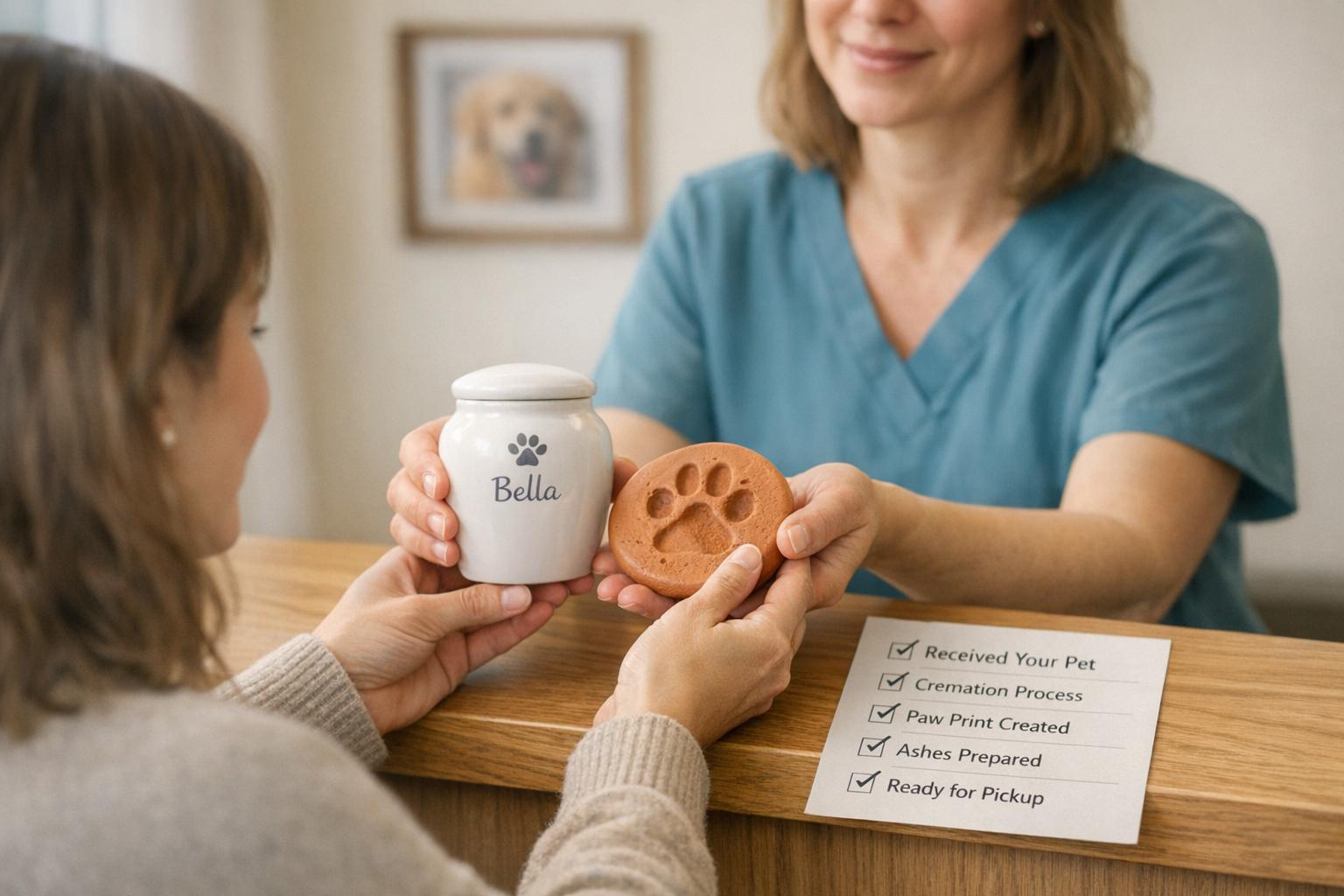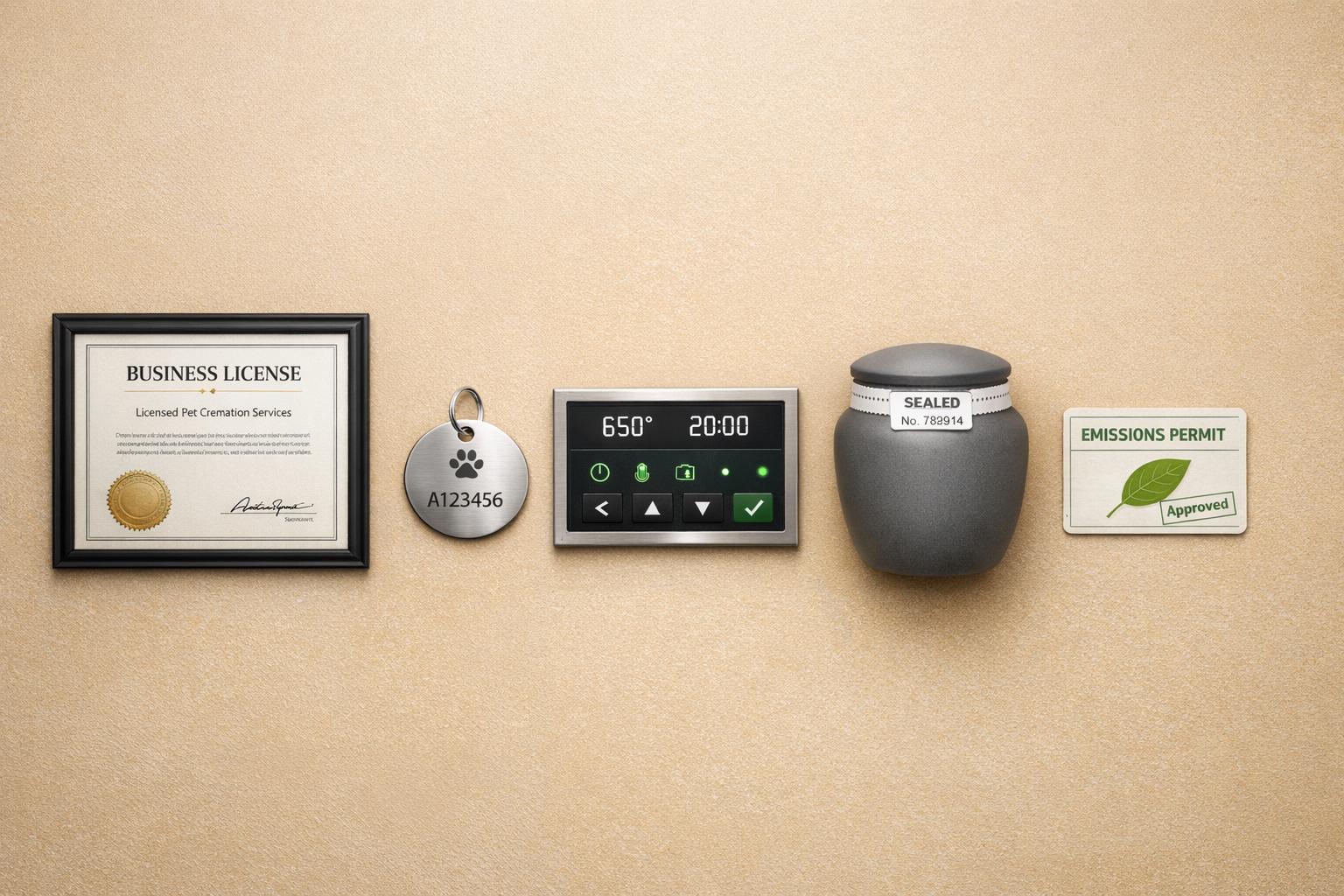
Losing a pet is hard, and choosing a cremation service can feel overwhelming. To protect pet owners and ensure fair practices, laws regulate pet cremation providers. Here are five key legal requirements every provider must follow:
- State Licensing: Businesses need proper licensing and must pass inspections to meet safety and operational standards. For example, New York requires a $150 license renewed every two years.
- Identification Systems: Providers must use reliable tagging systems to track remains and prevent errors or fraud. States like Colorado require dual-tagging for accuracy.
- Cremation Standards: Clear protocols exist for private and communal cremations to avoid mixing remains. Illinois law limits cross-contamination to no more than 1% in communal cremations.
- Ash Handling Rules: Documentation, like chain-of-custody forms, is required to track remains from start to finish. Permanent labels on containers ensure proper identification.
- Byproduct Disposal: Crematories must adhere to strict emission limits and are prohibited from burning anything other than animal remains and approved materials.
Non-compliance can lead to fines or even jail time, depending on the state. Always verify a provider’s licensing and ask about their processes to ensure your pet receives proper care.
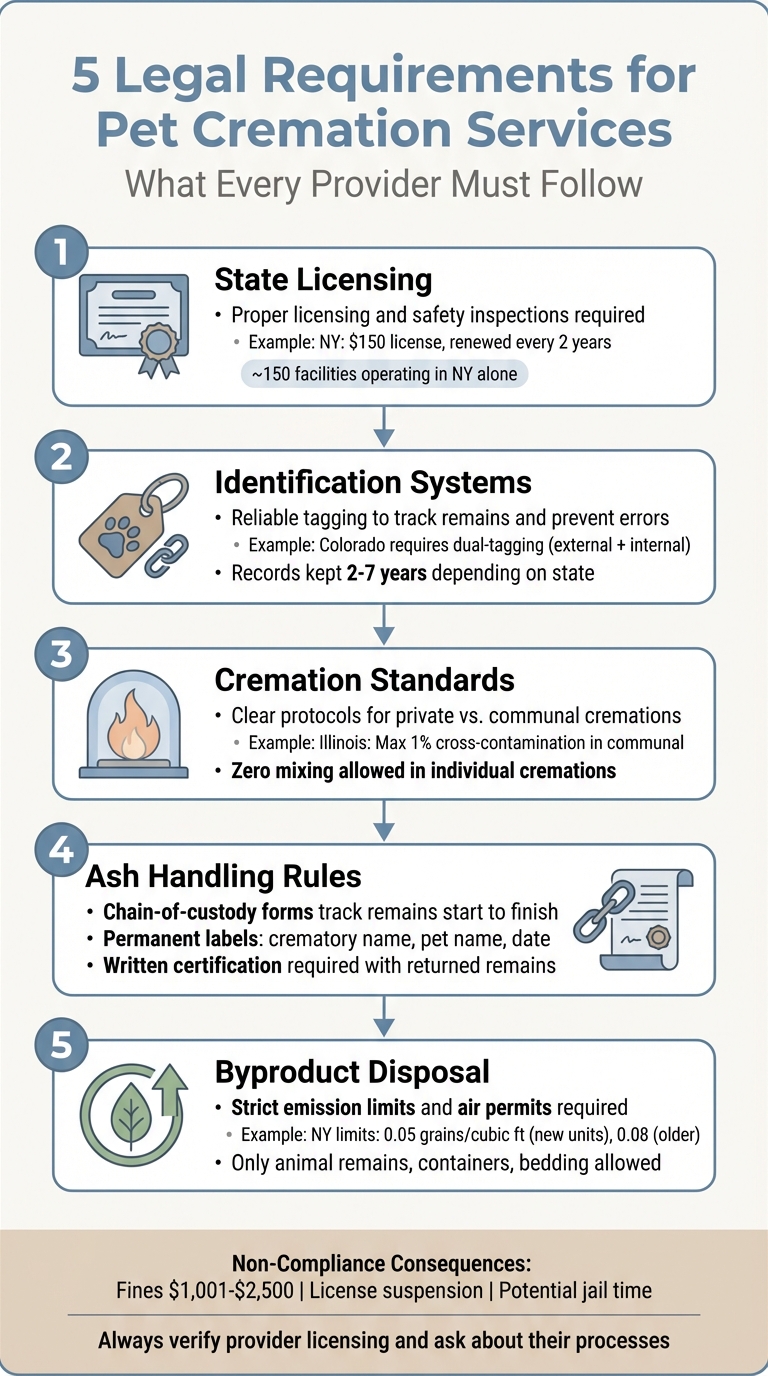
5 Legal Requirements for Pet Cremation Services Infographic
1. Obtain State Licensing for Pet Crematorium Operations
Compliance with State and Federal Laws
Operating a pet crematorium without proper licensing isn’t just risky - it’s illegal in most states and can result in heavy penalties. Licensing ensures that facilities meet strict safety and operational standards, protecting grieving pet owners from potential fraud. For example, in New York, there are about 150 crematory facilities currently operating under state regulation.
To apply for a license, businesses must submit detailed information about their operations, provide proof of relevant experience, and designate a "Responsible Owner" (a requirement in states like Arizona). Applicants also need to pass background checks, particularly for recent felony convictions.
| State | Licensing Authority | License Duration | Initial Fee |
|---|---|---|---|
| New York | Department of State (Division of Licensing Services) | 2 Years | $150 |
| Arizona | State Veterinary Medical Examining Board | 2 Years (Expires Dec 31 of even-numbered years) | Not specified |
State inspections play a key role in ensuring compliance with safety standards. Additionally, operators are often required to complete specialized training and pass a written exam to obtain a five-year animal crematory operator certificate.
Environmental Responsibility
Pet crematoriums must also adhere to strict environmental regulations. Facilities need air permits from agencies like the New York State Department of Environmental Conservation (NYSDEC) to monitor and control emissions. For example, New York enforces specific particulate matter limits based on when the cremation equipment was installed: units installed on or before March 14, 2020, must stay under 0.08 grains per dry standard cubic foot, while newer units are capped at 0.05 grains.
Crematoriums are strictly limited to burning animal remains, their containers, and incidental bedding. Burning municipal solid waste, pharmaceuticals, medical waste, or chemicals is explicitly prohibited.
These licensing and environmental rules ensure that pet cremation services operate safely, responsibly, and in compliance with the law.
2. Use Identification and Tagging Systems for Remains
Compliance with State and Federal Laws
Pet cremation facilities are required to follow strict identification protocols to ensure accuracy and prevent fraud. For instance, Illinois law mandates that providers include a formal certification with returned remains. This certification must confirm that the cremation was performed as promised - whether private, individually partitioned, or communal. Providers who fail to meet this requirement or submit false certifications can face fines ranging from $1,001 to $1,500 for a first offense, with penalties increasing to $2,000 to $2,500 for repeat violations.
In New York, pet crematoriums are required to maintain detailed records of disposal methods and confirm compliance with the owner's instructions. These records must be kept for two years. Failure to maintain accurate documentation can result in the suspension or revocation of the facility's operating license.
Transparency and Accuracy in Handling Remains
These regulations emphasize the importance of a reliable tagging system to maintain an unbroken chain of custody. Such systems ensure that pet remains are accurately tracked throughout the entire process. For example, Colorado law requires a dual-tagging approach: one tag must be attached to the urn or container's exterior, while a matching tag is placed inside with the remains. This method ensures identification even if the external tag is lost or damaged.
"Cremated remains shall have an identification tag attached to the urn or container holding the cremated remains and a matching identification tag shall also be placed inside the urn or container." - Colorado Office of Funeral Home and Crematory Registration
Additionally, every transfer of remains must include written documentation that records the names, signatures, titles, date, time, and identification method of both parties involved. Colorado requires crematories to keep these chain-of-custody records for five years, while funeral establishments must retain them for seven years. For example, Animal Aftercare employs a comprehensive tagging system to ensure complete transparency and provide pet owners with peace of mind, knowing their companion's remains are handled with care and precision.
3. Follow Cremation Process Standards for Private and Communal Options
Compliance with State and Federal Laws
Pet cremation providers must adhere to specific guidelines for each type of service they offer. For individual cremations, remains must be processed in separate chambers or divided by physical barriers to prevent mixing. On the other hand, communal cremations involve processing multiple animals together.
In Illinois, the law provides clear definitions to ensure clarity. For instance, in an individually partitioned cremation, multiple animals can be processed simultaneously, but partitions must fully separate them to minimize mixing. The law defines "commingling of significant amounts" as no more than 1% of remains by weight from other animals, which is acceptable for communal cremations but strictly prohibited in individual ones. These legal standards set the foundation for proper handling practices.
Transparency and Accuracy in Handling Remains
For individual cremations, remains must be promptly removed from the chamber and placed in a securely sealed container. This container must be permanently labeled with the crematory's name, the animal's name, and the cremation date. In communal cremations, remains are disposed of in accordance with legal requirements.
"The written explanation of services must not include any false or misleading information." – Illinois Companion Animal Cremation Act
Providers are obligated to give clients and referring veterinarians a detailed written description of each service level. When remains are returned, a certification must accompany them, confirming that the services were performed as described. Transparency in communication and proper documentation are essential to maintaining trust and compliance.
4. Follow Ash Handling and Documentation Protocols
Compliance with State and Federal Laws
Every step in the process, from receiving remains to returning ashes, needs to be carefully documented. To ensure accountability and reduce legal risks, chain-of-custody forms are used to track each phase of handling. These forms typically include details about the receipt, processing, and eventual return of the remains.
Some states, like Arizona, have specific rules about labeling. For instance, the container holding the remains must have a permanent label that includes the crematory's name, the pet's name, and the cremation date. Such detailed recordkeeping is essential for ensuring transparency in the return process.
Transparency and Accuracy in Handling Remains
Certain states require providers to issue formal certifications confirming that the cremation service was performed as promised. Additionally, a written explanation of the service provided must accompany the remains. In Illinois, any false certification is treated as a serious offense. A first violation results in a fine of at least $1,001, and subsequent offenses can lead to fines of up to $2,500.
To maintain accuracy and ensure an unbroken chain of identification, facilities often use metal tags with unique IDs throughout the entire ash-handling process. This system ensures that remains are properly tracked and returned to the correct individual or family.
sbb-itb-a4e988d
5. Meet Environmental and Disposal Regulations for Cremation Byproducts
Compliance with State and Federal Laws
Following licensing and identification protocols, adhering to environmental regulations is equally important for pet cremation facilities. These operations must obtain an air permit or registration based on their emissions. For example, in Florida, animal crematories may qualify for an "Air General Permit", which streamlines the registration process if they meet specific criteria.
To protect air quality, states enforce particulate matter limits. In New York, cremation units installed after March 14, 2020, must adhere to a limit of 0.05 grains per dry standard cubic foot, while older units are allowed up to 0.08 grains. These regulations ensure consistent environmental protections across more than 150 facilities in the state.
"DEC regulates cremation equipment by requiring crematory owners and operators to follow specific operating practices and other procedures designed to minimize smokestack emissions." - New York State Department of Environmental Conservation
Environmental Responsibility
Pet cremation facilities are only permitted to process animal remains, containers, and incidental bedding. Burning items like pharmaceuticals, medical waste, chemicals, or paints is strictly prohibited and violates environmental regulations.
To maintain compliance, facilities must keep detailed logs of operating parameters, regular maintenance, and inspections. Additionally, cremation equipment must be operated by a certified supervisor who has completed state-approved training and passed a written exam. In New York, these certifications remain valid for five years. Proper supervision and equipment handling are crucial for minimizing environmental impact while ensuring compliance with operational standards.
FT North America: Licenses & Permits Needed to Start a Pet Cremation Business
Conclusion
Selecting a pet cremation provider that adheres to these five legal requirements not only ensures your pet receives dignified care but also protects you from potential fraud. Providers that comply with regulations maintain proper licensing, implement identification systems to track remains, follow established cremation protocols, handle ashes responsibly, and meet regulatory standards. These measures safeguard grieving pet owners from situations like unknowingly paying for incomplete services or receiving ashes that may not belong to their pet.
Non-compliance carries serious consequences. In Illinois, fines start at $1,001 and can escalate to $2,500 for repeat violations. Additionally, there’s the risk of receiving commingled or incorrect remains, defined as exceeding 1% cross-animal remains.
This legal framework underscores the ethical responsibility of cremation providers.
"Pet cemeteries, their managers and owners have a special responsibility to their customers who have entrusted their pets' remains with them. These pet cemeteries have a duty to act in an ethical and lawful manner to prevent grieving pet owners from experiencing further any emotional pain or financial manipulation." - New York General Business Law, Article 35-C
Before choosing a provider, confirm its state licensing, request written documentation of services, and ask about its tagging and chain-of-custody protocols. At Animal Aftercare, we strictly follow these legal standards, including a 100% assurance tagging system and detailed chain-of-custody records, ensuring your pet’s remains are handled with the utmost care and respect. We offer compassionate, 24/7 nationwide services for pet cremation, equine cremation, and pet euthanasia.
Trust and compliance are essential during such a deeply emotional time.
FAQs
How can I verify if a pet cremation provider is licensed in my state?
To find out if a pet cremation provider is licensed in your state, reach out to your state's veterinary or licensing board. Organizations like the Arizona State Veterinary Medical Examining Board or the New York State Department of State keep records of licensed animal crematories. You can contact your state board directly to ensure the provider meets local licensing regulations.
What documents should I get to confirm my pet’s chain of custody?
To ensure your pet’s chain of custody is properly documented, gather records like tags, logs, or tracking paperwork. These should include clear details identifying your pet and its remains, such as transfer dates, source information, and the signatures of the authorized agent or owner. This documentation helps maintain transparency and ensures your pet is handled with care throughout the process.
How can I tell if a cremation is truly private vs. communal?
To ensure a cremation is genuinely private, it's crucial to confirm that only one pet is cremated at a time or that proper partitions are in place to keep remains separated. The remains must be clearly identifiable and returned to the owner, adhering to legal standards and established best practices. It's always wise to check the provider's procedures to ensure they follow these guidelines.